



 Hôtel Littéraire Arthur Rimbaud, BW Signature Collection by Best Western
How to enhance the guest experience in upscale hospitality: an interview with Fanny Lecomte, Area Manager at the Société des Hôtels Littéraires
At the Société des Hôtels Littéraires, each establishment pays tribute to a writer, from l'Hôtel Littéraire Gustave Flaubert in Rouen to the forthcoming Maison Littéraire George Sand in Bordeaux.
To understand how the guest experience is practically crafted in this context, we interviewed Fanny Lecomte, Area Manager of the group, in a question-and-answer format.
Could you introduce yourself briefly and tell us about your background?
I am Fanny Lecomte, Area Manager at la Société des Hôtels Littéraires, a group where the exacting standards of luxury mingle with the soul of a writer.
My role is to develop the literary concept and to support the general managers and their teams in the field on a daily basis.
Concretely, this ranges from the opening of a new property — I am currently assisting Julie with the opening of the Maison Littéraire George Sand — to recruitment, encompassing HR processes and numerous cross-functional matters, such as rethinking cultural itineraries to make them accessible to all.
In terms of career path, I entered by the small door, as a receptionist, then progressed to Front Office Manager, Deputy General Manager, Hotel Manager, and for the past two and a half years, Area Manager at the Société des Hôtels Littéraires.
Today, what in your view constitutes a genuine guest experience in a four‑star hotel?
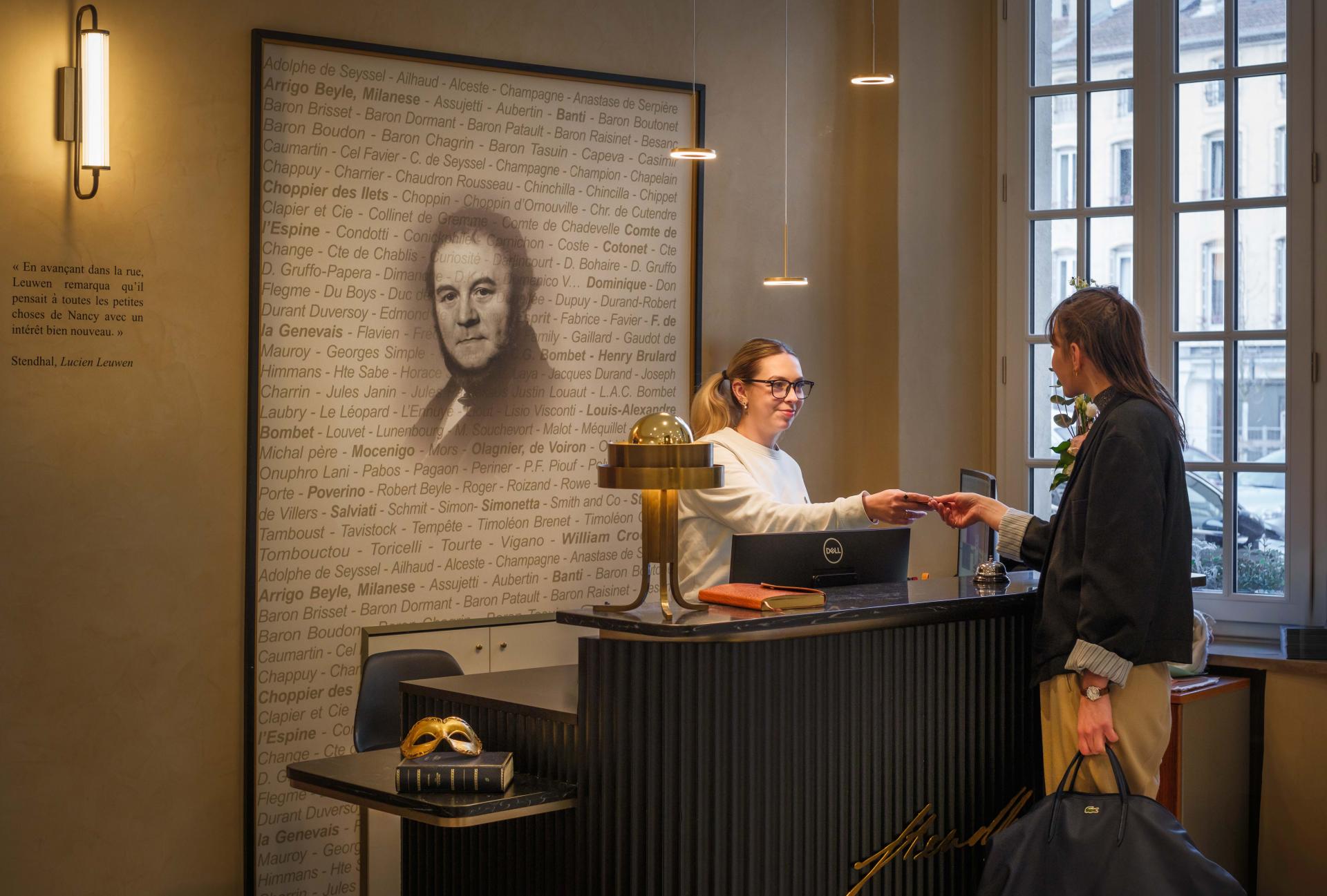
For me, a guest experience in a four-star establishment is the coherence between the hotel's promise and what it actually delivers to the guest at every stage of their journey. In a literary hotel, it is the author's identity that inhabits the place: from the choice of wallpaper to the choice of suppliers, everything must tell the same story. The guest of a four-star hotel today seeks not merely comfort, but to be transported, surprised, and to leave with something meaningful. To my mind, the true experience is when a guest returns home having lived something they could not have lived elsewhere.
From what moment does the guest experience truly begin?
It begins before arrival, before check‑in — the very moment the guest encounters us, whether on our website, on social media, or elsewhere. What we promise online must continue and come to fruition once they are with us, and even after they have departed. That is why I highlight everything we do at la Société des Hôtels Littéraires, such as our status as an entreprise à mission and our RSE commitments, so that the guest’s expectations align with what they will actually experience on site. The experience unfolds in three stages: before, the promise of the stay and the story we wish to tell; during, the ambience experienced on the premises, faithful to what they envisaged when reserving; after, the extension of the promise, through the boutiques and loyalty initiatives. If these three stages are not honoured, it does not work.
In a sector where levels of comfort and amenities tend to homogenize, has the experience become the principal factor of differentiation?
Entirely so, and I would even say that it is the very DNA of the Société des Hôtels Littéraires. Today, four‑star comfort is a given: everyone offers good bedding, air conditioning and wi‑fi. What truly makes the difference is meaning and experience. We have seven establishments, each conceived around a writer, with hundreds of cultural events per year and themed decor. This is not a whim; it is a deliberate strategy of differentiation through content and narrative. In a sector where facilities resemble one another, distinction lies in what cannot be copied: our history, our identity, our universe down to the smallest detail.
How does one find the right balance between service standardisation, indispensable in hospitality, and the personalisation of the guest experience?
They are two distinct yet complementary matters. Standardisation is the foundation: a guest must be able to rely upon a constant level of service, particularly in all matters pertaining to operations — reception, cleanliness, punctuality, and amenities. It is a painstaking task that ought to remain invisible. Personalisation, for its part, is what makes the difference. In our house, there exists a genuine balance: well-defined processes, internal regulations, and precise job descriptions that furnish the teams with a solid framework from which to improvise and tailor the experience. Without that standardisation, one cannot offer personalisation. One requires both: standardisation reassures, and it is what enables the teams to personalise the welcome.
What are the specific expectations of guests at a 4‑star hotel today, and have they evolved in recent years?
They have clearly evolved. Today, the guest does not merely expect a stay; they expect an experience, service of the highest order, a narrative, values, a certain soulfulness — that subtle flourish which distinguishes one establishment from another. This is manifest notably in guests’ heightened demand for authenticity and commitment. That is why it is imperative that we fully embody our thematic focus, with our status as a purpose-driven company, our values, the Clé Verte certification, and our CSR commitments. There is also a strong expectation regarding accessibility and inclusion: we are currently revising, together with Axel, our Head of CSR, all our cultural programmes to make them genuinely accessible to everyone, including through partnerships with schools. It is not merely a matter of image; it is truly the hotel’s values that matter.
What role does digital play in the guest experience, notably before the stay and after departure?
Before the stay, it is the first chapter: it is there that the guest discovers the universe of the hotel. One must therefore above all not fail with the visuals used as a promise, so that the guest may project themselves. After their departure, we also need it to continue the story, with editorial content, chronicles, portraits. It is an instrument that allows the story to be prolonged, but it must remain an instrument: it must never replace human interaction.
How may one deploy guest knowledge and available data to personalise the stay without causing the guest to feel "monitored"?
What matters above all is the intention as perceived by the guest. If data are employed to anticipate a need, it is experienced as a mark of consideration. Conversely, the same data used clumsily are felt to be an intrusion. It is the teams who make all the difference: the guest must feel that it is human beings who remember them, not a machine or an algorithm. Concretely, this may take the form of a pillow menu adapted to the guest’s allergies — we already do this at the Maison Littéraire George Sand —, a gluten‑free breakfast plate prepared with the same ingredients as the others, or an in‑room gesture for a wedding anniversary noted on the guest file without the guest having mentioned it.
A foretaste of the Maison Littéraire George Sand
To what extent does the experience offered to guests depend, above all, on the teams and on their ability to embody the hotel's identity?
It is truly the very heart of my profession. If the team does not make the establishment's story its own, nothing is conveyed to the guest. This also involves recruitment, a matter Julie and I are currently reworking at the Maison Littéraire George Sand and which I wish to develop throughout: technical skills are a foundation, but what leads us to hire one person rather than another is their ability to tell, embody and breathe life into the universe of our writers on a daily basis. We may craft the most beautiful website and the most elegant messages, yet if the experience is not lived and the teams do not guide the guests, all of that remains empty. Guest experience is a team that believes in what it tells.
How does one measure a truly good guest experience today: do online reviews and satisfaction scores suffice, or ought one to consider additional indicators?
Online reviews and rating are necessary, yet they are not sufficient. They chiefly capture the extremes of experience — a guest who is exceedingly pleased or exceedingly displeased — without subtlety. One must also attend to what remains unseen: the loyal guests who return without ever leaving an online comment, word of mouth, and the manner in which the teams experience their roles, for that speaks volumes. In a hotel, the first thing one perceives upon arrival is the human interactions. When a team feels well in their work, everything reflects upon the guest.
How does one distinguish the guest experience at the Société des Hôtels Littéraires?
Each hotel is built around a writer, and this identity is reflected in absolutely everything: the architecture, the objects, the cultural programming, even the reception procedures. We are also committed establishments, certified by Clé Verte, and hold the status of a mission-driven company. The difference does not stem from a single lever, but from the coherence among all these elements. A matter particularly close to my heart is making this culture accessible to everyone, not only to an already initiated audience: whether children or people with disabilities, literature must be addressed to all. The aim is not merely to speak to readers, but also to open the world of reading to non-readers.