


 Hôtel Littéraire Arthur Rimbaud, BW Signature Collection by Best Western
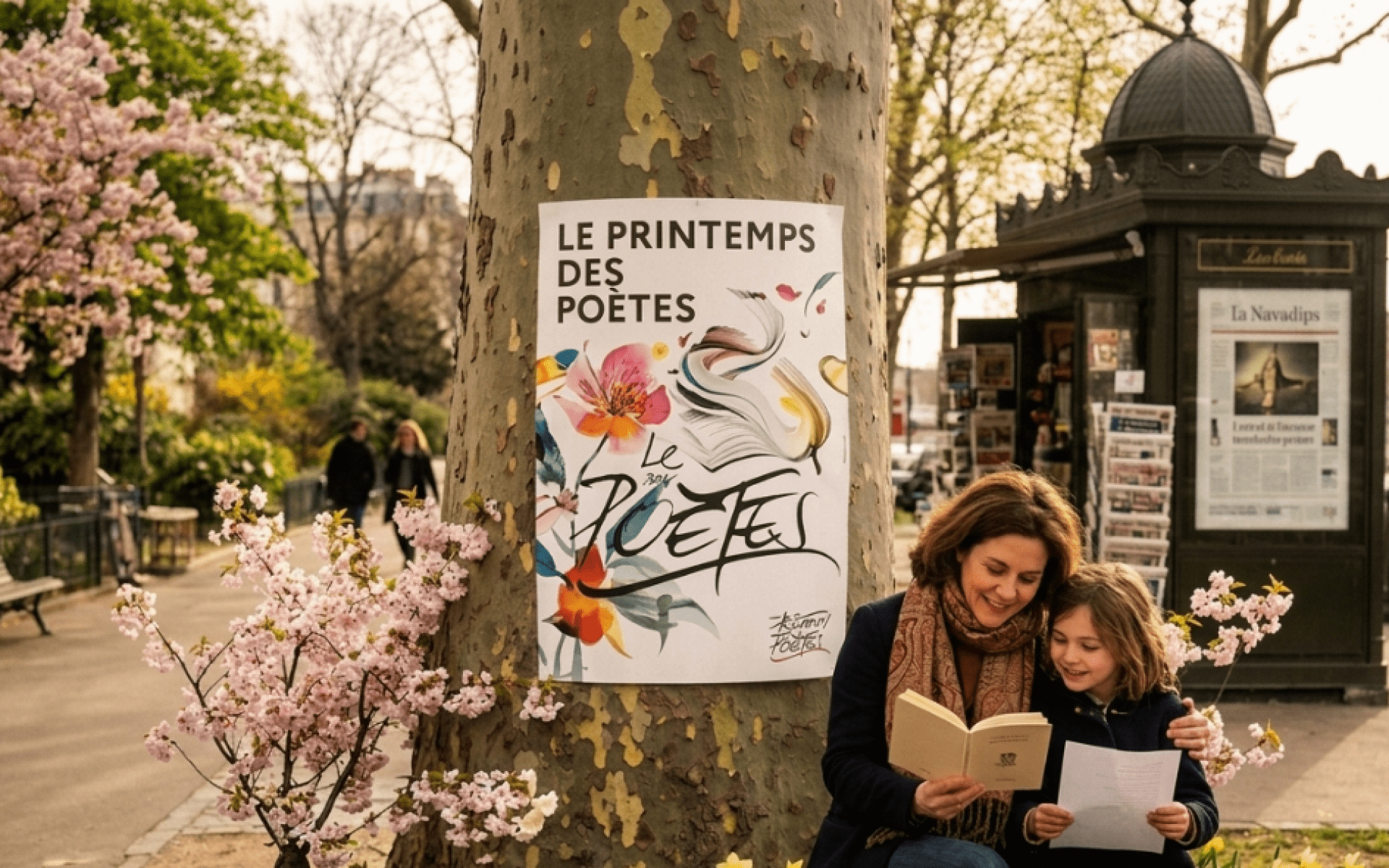
Printemps des Poètes 2026: A Season of Freedom and Poetic Momentum
When Paris began to whisper in verse
In March 2026, something invisible swept across France.
In the still-cool streets at the end of winter, between two hesitant rays of sunlight, voices rose. Words circulated—whispered in libraries, declaimed in theatres, scribbled in the margins of notebooks.
Like a gentle murmur.
Sometimes, a single line of poetry is enough to change the color of a day.
Arthur Rimbaud, whose vivid presence still lingers in minds and places, wrote in Une saison en enfer:
“It is necessary to be absolutely modern.”
And yet, in that month of March, it was a very particular kind of modernity that emerged:
that of a timeless poetry, capable of suspending time.
The 2026 Printemps des Poètes, under the theme
“Freedom. A living, unfolding force",
thus offered a rare interlude—a collective breath, almost essential.
I. A 2026 Edition carried by the breath of poetry
A celebration that has become essential
Since its creation in 1999 by the Ministry of Culture, and now organized by the Centre de la Poésie, the Printemps des Poètes has honored the language of poets and allowed their voices to resonate throughout the country.
This 28th edition, held from March 9 to 31, 2026, once again transformed the nation into a vast poetic stage.
Everywhere:
in schools
in bookshops
in gardens
in cultural venues
words reclaimed their place.
Not as a luxury.
But as a necessity.
"Freedom" : A theme embodied
The theme of this edition,
“Freedom. A living, unfolding force”,
found a particularly strong resonance in the readings and performances presented.
Freedom to speak.
Freedom to write.
Freedom to be.
The works of Rimbaud, Paul Éluard, and René Char resonated with renewed intensity, reminding us how poetry has always been a space of emancipation.
In Charleville-Mézières, the birthplace of Arthur Rimbaud, exhibitions and readings offered a sensitive immersion into his world, bringing together archives, contemporary creations, and artists’ perspectives.
II. A poetry lived, shared, embodied
Events that made cities resonate
The Printemps des Poètes is not a fixed festival.
It is a movement.
In 2026, initiatives blossomed with a joyful spontaneity:
readings aloud in cafés
open mic sessions
writing workshops
poetic installations in public spaces
In Paris, certain readings transformed familiar places into suspended spaces, where time seemed to slow down.
We paused.
We listened.
We felt.
The return of sensibility in a fast-paced world
Reading a poem aloud.
Turning the pages of a collection.
Sharing a text.
Simple gestures, yet suddenly precious.
Poetry reclaimed its essential role:
that of creating connection.
III. Literary Hotels: Refuges to Extend the Experience
Places where literature becomes a way of life
In this poetic momentum, certain places offered a natural extension of the experience: literary hotels.
Conceived as living tributes to writers, they offer far more than a stay.
They invite guests to:
read differently
inhabit a work
immerse themselves in a universe
Among them:
Hôtel Littéraire Arthur Rimbaud
Hôtel Littéraire Le Swann
Hôtel Littéraire Stendhal
Each creates a singular atmosphere, somewhere between an intimate library and an urban refuge.
A Poetic Season Experienced from Within
During the 2026 Printemps des Poètes, these hotels fully embraced the festival’s vibrant energy.
At the Hôtel Littéraire Arthur Rimbaud, several evenings shaped the month of March: readings centered on the anthologies Chemins de liberté and Liberté – Visas pour un monde ouvert, encounters with contemporary poets, and an exhibition dedicated to Yves Bonnefoy, presented on the occasion of World Poetry Day.
In the elegant salon of the Hôtel Littéraire Le Swann, the Prix Max Jacob ceremony brought together authors and poetry enthusiasts, celebrating the vitality of contemporary poetic creation.
The momentum will extend beyond Paris, notably at the Hôtel Littéraire Stendhal, where a poetic evening in early April will continue this sensitive exploration of freedom.
In these spaces, poetry was not merely read.
It was shared, murmured, experienced differently.
The visitor was no longer a spectator.
They became a reader, a listener, almost a confidant.
Reading, Staying, Feeling
Staying in a literary hotel means extending the Printemps des Poètes beyond the duration of the event.
It is opening a book at random, letting a sentence resonate, or carrying away a line discovered almost by chance.
In a world that often moves too quickly, these places offer a different kind of pause—slower, more attentive, more sensitive.
A discreet yet precious way of keeping poetry alive.
What the Printemps des Poètes Leaves Behind
As March came to an end, the voices gradually fell silent.
And yet, something remained.
A rhythm.
A renewed attention to words.
Perhaps, a desire to read.
The Printemps des Poètes never truly disappears.
It leaves behind invisible traces, like an inner melody.
And sometimes, all it takes is stepping into a place to rediscover that feeling.
In Paris, the Hôtel Littéraire Arthur Rimbaud continues this spirit with a particular delicacy, faithful to the intensity of the poet.
A little further away, the Hôtel Littéraire Le Swann invites another kind of journey, through the meanders of memory and time.
Because poetry, in the end, never truly stops.
It simply changes place.
Written by Léa Geoffray